

Most small companies prove their sales motion by hand. The founder takes the calls, writes the follow-ups, remembers which deals are real and closes because nobody knows the buyer better.
That's the right way to start. It's the wrong way to keep going. Once the motion is proven, the job changes from finding out what works to making what works run the same way every week, without one person carrying it.
This guide is about that second job. It covers how to tell when a motion is proven, the three seats that sit around a healthy pipeline, how partner introductions turn into a loop rather than a favor, what a discovery call should reveal, and the weekly rhythm that holds it together.
1. When a motion counts as proven
"Proven" doesn't mean big. It means repeatable and explainable. A useful test is whether someone other than the founder can answer four questions without checking with them:
- Who buys? The kind of company, its size and the person who signs, in one sentence.
- Why do they buy? The problem they're trying to solve, in the words buyers actually use.
- How does a deal move? What has to be true before a conversation becomes an opportunity, a proposal and a close.
- What happens after each call? What the buyer receives, from whom and by when.
If those answers live only in the founder's head, the motion isn't proven yet. It's remembered. Keep proving, and write down what you learn as you go. If the answers are clear and written, it's time to build the system around them.
2. Three seats around one pipeline
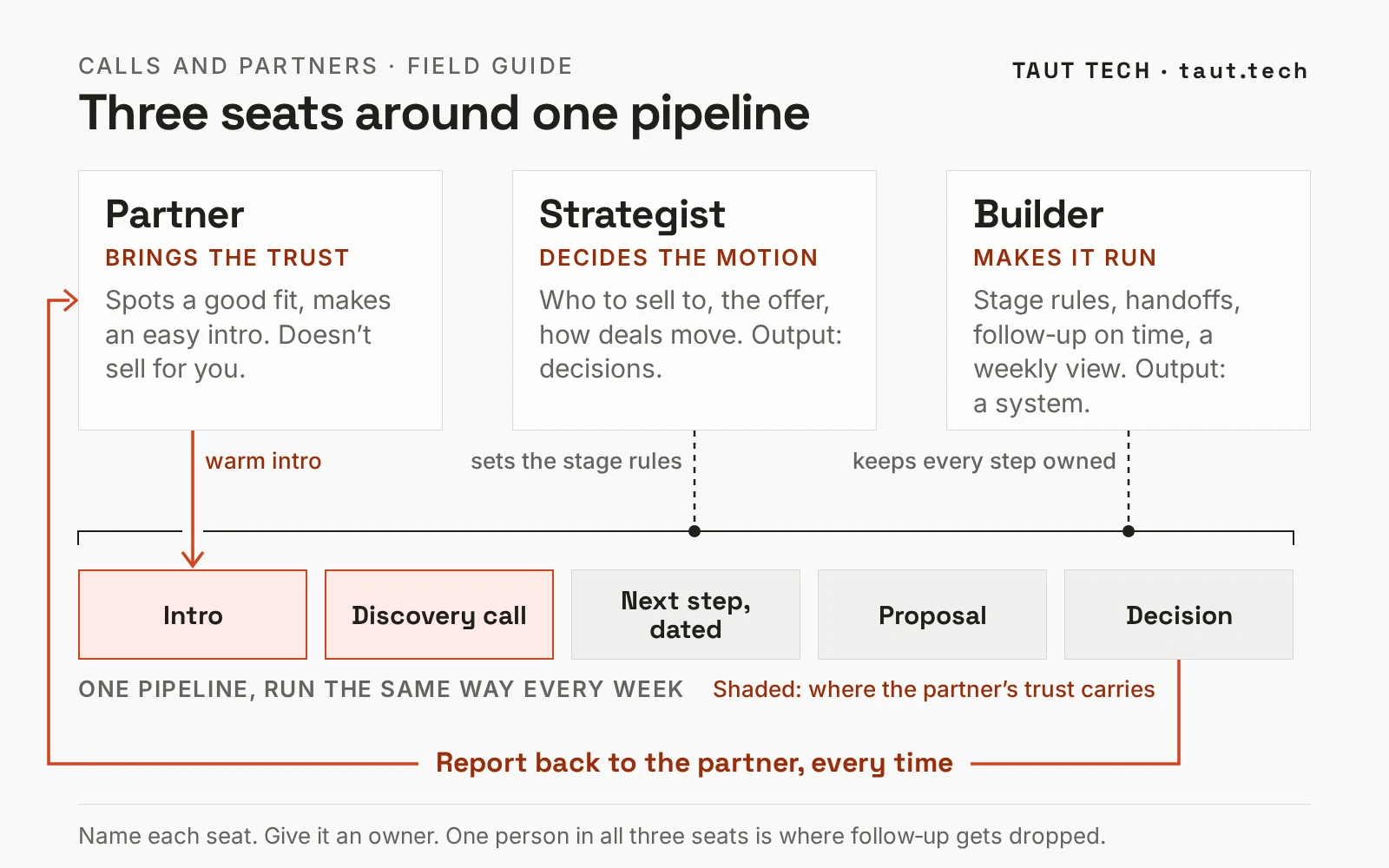
As a company gets serious about sales, it often brings in outside help. That help tends to fall into three seats. Each one does a different job, and the pipeline runs best when everyone knows which seat they're in.
The partner brings trust. An accountant, an agency, a fractional executive, a peer founder or a former customer. Partners already have the buyer's confidence, and their introduction starts the first call warm. A partner's job is to recognize a good fit and make an easy introduction. It isn't to sell for you.
The strategist decides the motion. Often a fractional chief revenue officer or a sales consultant. The strategist decides who to sell to, what the offer is, how pricing works, how deals should move and what the team should be measured on. Their output is decisions.
The builder makes it run. The builder turns those decisions into a working system: pipeline stages with clear entry rules, handoffs that don't depend on memory, follow-up that goes out on time, a place where partner intros are logged and answered, and a weekly view the founder can read in one sitting. Their output is a system that runs on an ordinary week.
When the seats blur
Most trouble starts when one person tries to sit in more than one seat, or when a seat is empty.
- A strategist who ends up configuring software has less time for the decisions only they can make.
- A builder who has to guess at strategy will build a tidy system around the wrong motion.
- A partner who sends an intro and never hears what happened will stop sending.
- A founder sitting in all three seats becomes the bottleneck, however capable they are.
None of this needs three separate firms. In a small company, one person might cover two seats for a while. What matters is that each job is named and someone owns it.
3. The partner loop
A referral channel works as a loop, not a funnel. Intros come in, you handle them well, you report back, and the partner learns enough about your fit to send a better one next time. Break any step and the loop stops.
- Make the fit easy to spot. Give partners one sentence describing who you help and the problem you solve. If they have to think about it, they won't make the intro.
- Make the intro easy to make. A short note they can forward, or a link to book a call. Remove every step you can.
- Answer the intro the same day. A warm introduction cools quickly. Reply while the partner's endorsement is still fresh in the buyer's mind.
- Report back, every time. Tell the partner what happened within a week, including when it's a no and why. This is the step most firms skip, and it's the one that keeps the loop alive.
- Thank them in a way that fits their lane. For some partners that's a referral in return. For others it's simply making them look good to their client. Ask what matters to them.
Write the loop down and give each step an owner. If the report back depends on someone remembering, it won't happen.
4. What a discovery call should reveal
A discovery call is a diagnostic, not a pitch. You're there to find out whether there's a real problem, whether it's worth solving now and whether you're the right one to solve it. By the end, you should know five things:
- The problem, in their words. Not your category name for it. Their description, which you'll use in every follow-up.
- What waiting costs them. If nothing changes for six months, what happens? A problem with no cost of waiting rarely turns into a decision.
- Who else decides. Most purchases involve more than one person. Find out who, and what each of them cares about.
- How they buy. Budget timing, approval steps, anything they've tried before and why it didn't stick.
- The next step, with a date. Something the buyer agrees to, not something you hope for. A call that ends with "I'll think about it" and no date hasn't ended yet.
If you hang up missing one of these, book a short follow-up and ask it there. Guessing is how good conversations go quiet.
After the call
The hour after a discovery call matters as much as the call. Send the buyer a short recap in their own words: the problem, what it's costing them, the next step and the date. Log what you learned where the rest of the team can see it. If the call came from a partner, this is when the report back starts.
5. Running it week to week
A proven motion runs on a simple weekly rhythm. It doesn't need to be elaborate. It needs to happen every week, whether or not the founder is in the room.
- One pipeline review. Short and at the same time each week. Look at what moved, what's stuck and what has no next step.
- Stage rules that everyone follows. A deal only moves when its entry rule is met. If a rule keeps getting bent, change the rule rather than ignoring it.
- An owner for every follow-up. Every open conversation has a name and a date next to it.
- A partner check. Which intros came in, which ones got a report back, and which partners haven't heard from you lately.
- One number the founder reads. Pick the measure that tells you whether the motion is healthy, and look at the same one every week.
6. Signs a seat is empty
- No partner seat: every new conversation starts cold, and the founder's personal network is the only warm source.
- No strategist seat: the team works hard, but nobody can say in one sentence who the ideal buyer is or why deals are won and lost.
- No builder seat: the strategy is sound on paper, but follow-ups slip, stages mean different things to different people and the weekly review keeps getting skipped.
If one of these sounds familiar, that's the seat to fill first.
Where to go next
- For the research on why partner introductions tend to outwork cold volume for small firms, read Warm beats wide on the blog.
- If you'd like to see where your own pipeline stalls, Start Audit. It's four questions.
- If you're a strategist or a partner and want to talk about how the seats could work together on a client, book a call or see how we work with partners.