

Cold volume feels like progress because it's easy to count. Emails sent, sequences live, dials made. A dashboard full of activity looks like a pipeline.
For a company of five to fifty people, it usually isn't. A small firm doesn't need the most conversations. It needs the right ones, started by someone the buyer already trusts. That's what a partner or referral channel gives you, and it's why we'd put the next hour there before we'd put it into more volume.
This post covers what the research says, where cold outreach still earns its place, and what a partner channel needs so it keeps producing intros instead of going quiet.
What the numbers say about cold volume
Cold outreach works in the sense that some people say yes. The question is how many, and what the rest of the effort costs.
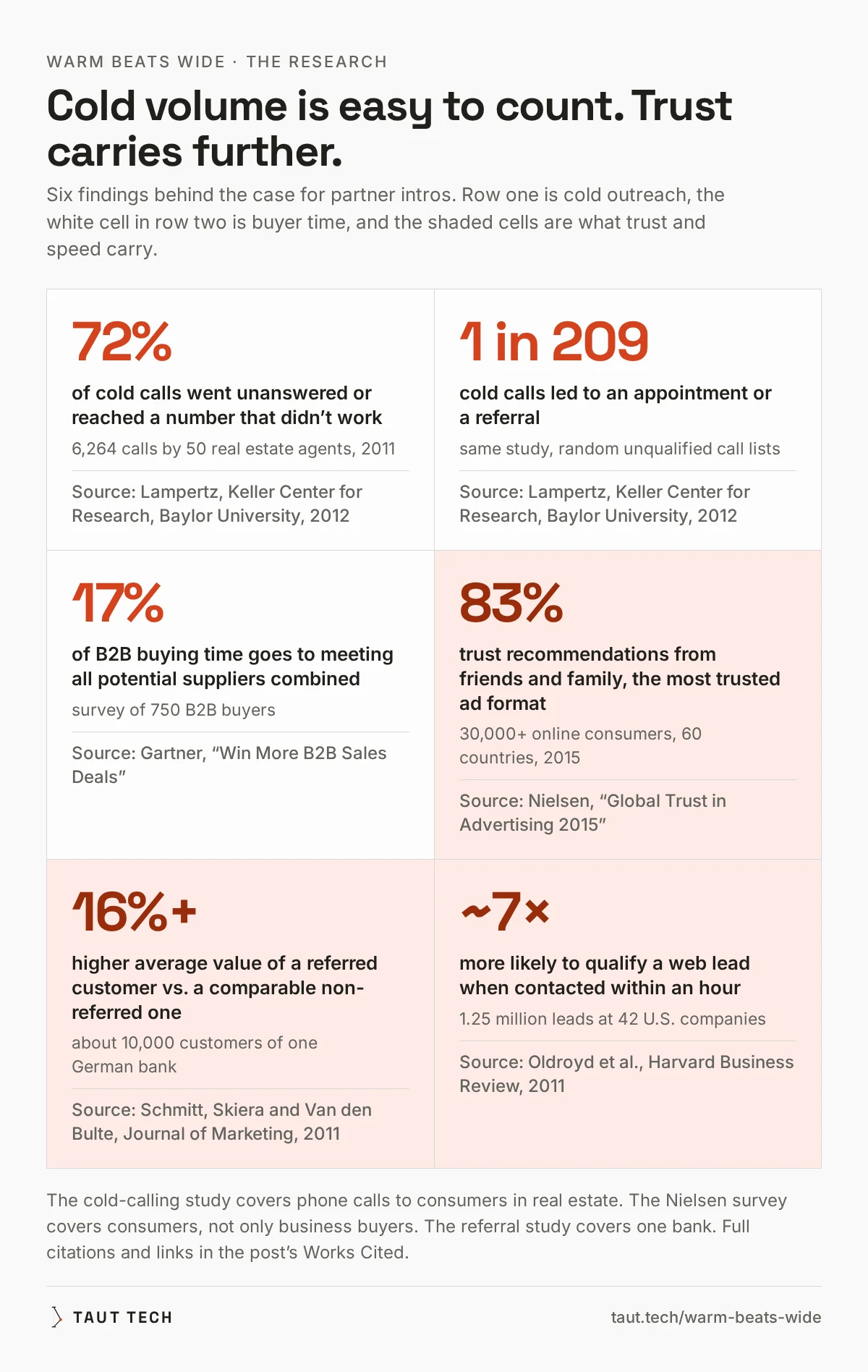
One of the few independent measurements comes from Baylor University's Keller Center for Research. In November 2011, 50 real estate agents worked through random, unqualified phone lists and made 6,264 cold calls. 72% of those calls went unanswered or reached a number that didn't work, and across the whole study, one call in 209 led to an appointment or a referral. The author read that as a workable return for agents willing to put in the hours. It's also a consumer market, not business buyers, and it's phone, not email. But the shape is the useful part: most of the effort goes into contacts that never become a conversation.
And a conversation isn't a buyer. In that same study, most people who did pick up weren't interested: 1,612 of the 1,774 answered calls.
Buyers give sellers less time than you think
Even when a conversation starts, the seller's slice of the buyer's attention is small. In a 2017 survey of 750 B2B buyers, Gartner found that buyers spend only 17% of their buying time meeting with potential suppliers. When they're comparing several suppliers, any one seller may get only 5% to 6%.
That's the real constraint. If you only get a sliver of the buyer's time, it matters a great deal whether that sliver starts at zero or starts with someone they already trust vouching for you.
What trust carries in
People believe the people they know. In Nielsen's global survey of more than 30,000 online consumers in 60 countries, recommendations from friends and family were the most trusted form of advertising: 83% said they completely or somewhat trust recommendations from friends and family. That's a consumer survey from 2015, not a study of business buyers, so treat it as a signal about people rather than a B2B benchmark.
The stronger evidence on value comes from a study published in the Journal of Marketing. Researchers tracked about 10,000 customers of a German bank and found that the average referred customer was at least 16% more valuable than a comparable customer who wasn't referred, with higher retention that persisted over time. The authors also note that the gap varied by customer segment, so referrals aren't magic for everyone. Still, the direction is clear: people who arrive through someone they trust tend to stay.
For a small firm, that's the point of a partner channel. An accountant, an agency, a fractional executive or a peer founder already has the relationship. Their intro doesn't just get you a meeting. It gets you a meeting that starts further along.
Warm leads still go cold if you're slow
A warm intro isn't a closed deal. It decays like any other lead. In an analysis of 1.25 million leads at 42 U.S. companies, firms that tried to contact a lead within an hour were nearly seven times as likely to qualify it as firms that waited even an hour longer. The HBR article is paywalled, but an open news write-up quotes the same figures. The study is from 2011 and looked at web leads, not referrals, but the lesson carries: an intro from a partner deserves a same-day reply.
Warm conversations can also stall for reasons that have nothing to do with interest. In an analysis of more than 2.5 million recorded sales conversations, between 40% and 60% of deals were lost to buyers who said they intended to buy but never acted. That's where a good discovery call earns its keep. It should leave you knowing the problem in the buyer's words, what waiting costs them, who else decides and what the next step is, with a date on it.
Where your next hour goes
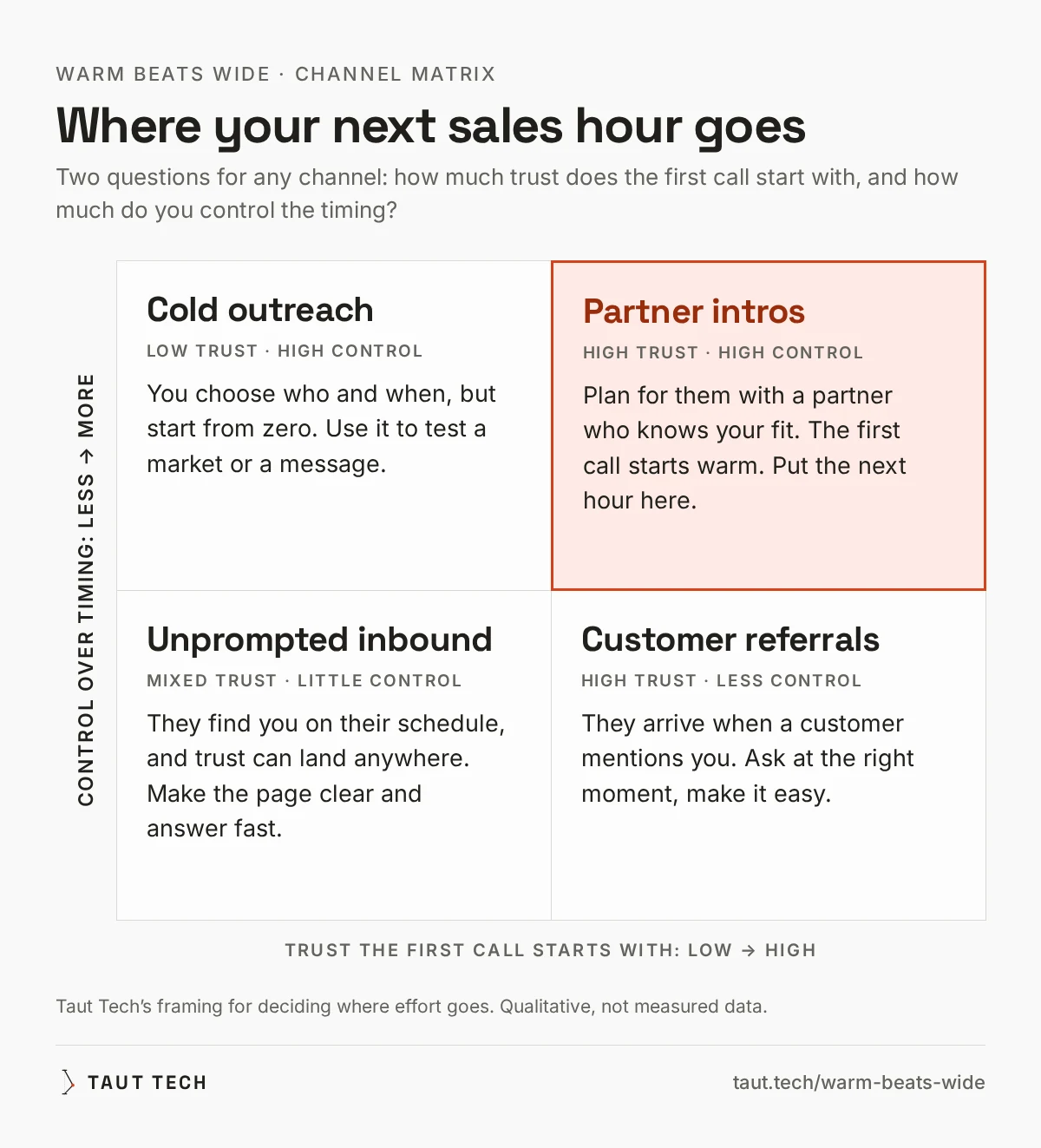
We use a simple two-by-two to decide where effort goes. One axis is how much trust the first call starts with. The other is how much control you have over timing.
- Partner intros (high trust, high control). You can plan for these with a partner who knows your fit, and the first call starts warm. For most small firms, this is where the next hour should go.
- Customer referrals (high trust, less control). These arrive when a happy customer happens to mention you. Ask at the right moment and make the intro easy, but you can't schedule them.
- Cold outreach (low trust, high control). You choose who and when, but you start from zero. It's useful for testing a new market or message, and for reaching buyers no partner knows yet.
- Unprompted inbound (mixed trust, little control). Someone finds you on their own schedule. Make the page clear and answer fast.
This is our framing, not a measured result. It's a way to have the conversation with yourself before you buy another list.
When cold still makes sense
We're not anti-outbound. Cold outreach is the right call when you're entering a market where you have no network, when you need to test whether a message lands before asking partners to repeat it, or when your buyer simply isn't connected to anyone you know. Small, specific lists sent by a person who has done the homework will beat large, generic ones.
The mistake is treating volume as the default. When a channel isn't producing conversations, the answer is rarely a fifth rewrite of the message. It's usually a different channel.
What a partner channel needs
Partner channels don't run themselves. The ones that keep producing intros tend to have three things in place:
- A clear picture of who you help. One sentence a partner can repeat without thinking: the kind of company, the size, the problem. If they have to guess, they won't make the intro.
- An easy way to make the intro. A two-line note they can forward, or a short link to book. Remove every step you can.
- A report back, every time. Tell the partner what happened within a week, even when it's a no. Partners who never hear back stop sending. Partners who do hear back learn your fit and send better intros next time.
Then the follow-through on your side has to hold up: a same-day reply to the intro, a discovery call with a clear agenda, a next step the buyer actually agrees to, and someone who owns each of those steps. That's a system, not a personality trait. It's the part we build.
Where to go next
If you want the frameworks behind this, including the three seats around a pipeline (partner, strategist, builder) and what a discovery call should reveal, read our field guide: Calls and partners.
If you'd like a first look at where your own pipeline stalls, the four-question audit gives you a read based on your answers and your site. Or book a call.
Works Cited
- Adamson, Brent, editor. Win More B2B Sales Deals: How Sales Delivers More Value to Today's Buyers. Gartner, 2018, emt.gartnerweb.com/ngw/globalassets/en/sales-service/documents/trends/win-more-b2b-sales-deals.pdf. Accessed 2 Nov. 2026. Data from the Gartner 2017 Digital B2B Buyer Survey.
- Barrett, Sue. "Are You Letting Online Leads Go Cold?" SmartCompany, 1 July 2011, www.smartcompany.com.au/marketing/20110704-are-you-letting-online-leads-go-cold/. Accessed 2 Nov. 2026.
- "Digital Formats Are Among the Most Trusted Advertising Sources Despite Slow Growth." Nielsen, Sept. 2015, www.nielsen.com/insights/2015/digital-formats-are-among-the-most-trusted-advertising-sources-despite-slow-growth/. Accessed 2 Nov. 2026.
- Dixon, Matthew, and Ted McKenna. "Stop Losing Sales to Customer Indecision." Harvard Business Review, 24 June 2022, hbr.org/2022/06/stop-losing-sales-to-customer-indecision. Accessed 2 Nov. 2026.
- "Global Trust in Advertising: 2015." Nielsen, Sept. 2015, www.nielsen.com/insights/2015/global-trust-in-advertising-2015/. Accessed 2 Nov. 2026.
- Lampertz, Dale. "Has Cold Calling Gone Cold?" Keller Center Research Report, Keller Center for Research, Baylor University, 1 Sept. 2012, kellercenter.hankamer.baylor.edu/news/story/2012/has-cold-calling-gone-cold. Accessed 2 Nov. 2026.
- Oldroyd, James B., et al. "The Short Life of Online Sales Leads." Harvard Business Review, Mar. 2011, hbr.org/2011/03/the-short-life-of-online-sales-leads. Accessed 2 Nov. 2026.
- Schmitt, Philipp, et al. "Referral Programs and Customer Value." Journal of Marketing, vol. 75, no. 1, Jan. 2011, pp. 46–59, doi.org/10.1509/jm.75.1.46. Accessed 2 Nov. 2026. Author PDF at faculty.wharton.upenn.edu/wp-content/uploads/2012/04/Schmitt-Skiera-vandenBulte-2011-Referral-Programs-Customer-Value.pdf.